
Grid failures are not a matter of if, but when. Securing reliable backup power is not optional; it is a fundamental component of home preparedness. This guide details practical, actionable strategies for maintaining essential services when the grid goes dark. Proactive planning ensures your household remains functional and safe during extended outages.
Assessing Your Critical Power Needs
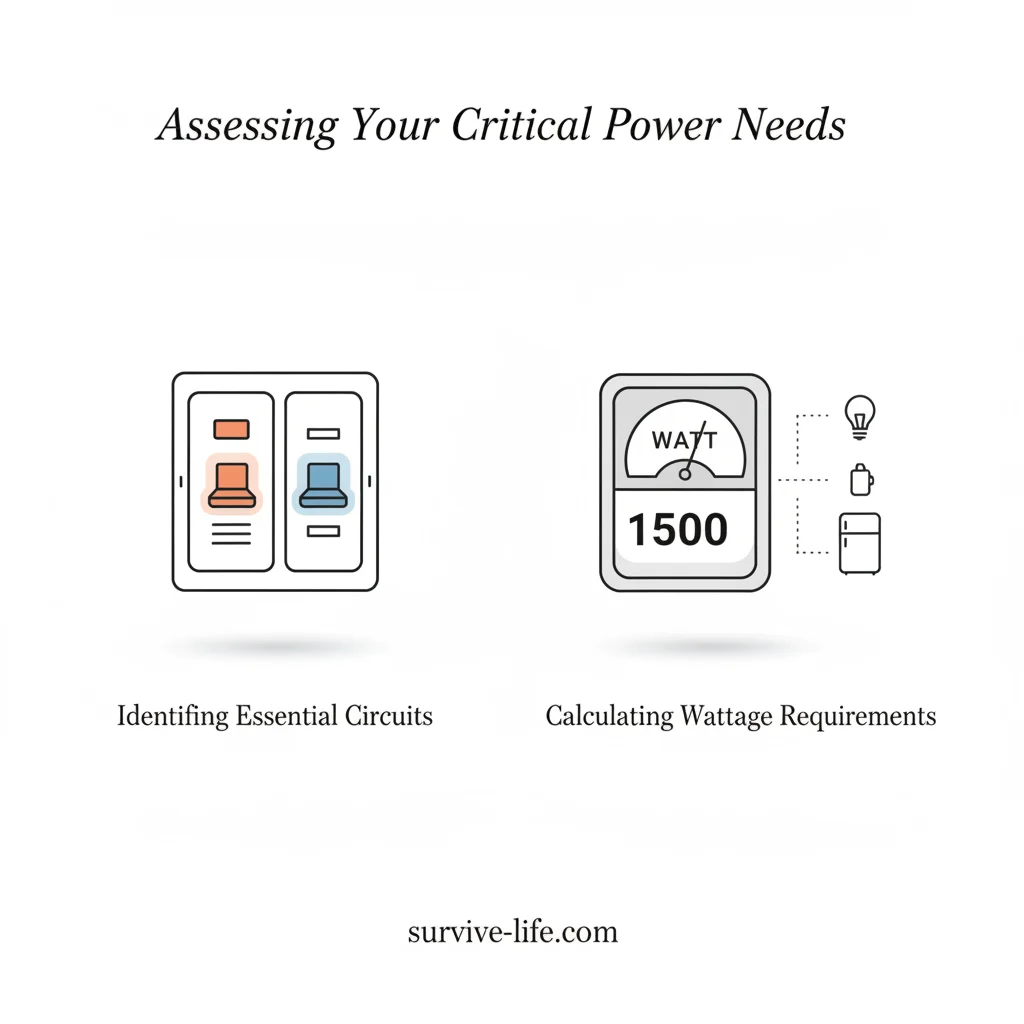
Before acquiring any power solution, identify what absolutely must run. Prioritize medical devices, communication equipment, refrigeration, and essential lighting. Overlooking this crucial step leads to wasted resources and inadequate coverage when an emergency strikes. A thorough assessment prevents costly mistakes and ensures your investment directly addresses your most pressing needs.
Identifying Essential Circuits
Map out the circuits in your home that power critical appliances. Understand which outlets and devices are linked to these circuits. This often involves consulting your home’s electrical panel and potentially testing outlets with a simple circuit tester. Labeling your breaker panel clearly helps identify critical circuits quickly during an emergency. Furthermore, knowing your circuit layout prevents accidental overloading of your backup system.
Calculating Wattage Requirements
Sum the running and surge wattage for all essential devices. This dictates the minimum output capacity required from any backup system. A typical modern refrigerator, for instance, might draw 150-200 running watts but surge significantly higher on startup, sometimes up to 1000-1200 watts for a few seconds. Medical devices like CPAP machines typically run between 30-60 watts, while a small chest freezer might draw 70-100 running watts with a surge of 500-700 watts. Consult appliance labels or manufacturer specifications for precise figures. Always factor in a substantial buffer for these surge demands to prevent system overload. Underestimate your power needs, and your system will fail when you need it most.
Consider the duration you need these devices to run. A refrigerator cycles on and off, so its average daily consumption is lower than its running wattage suggests. However, communication devices and medical equipment may require continuous power. Documenting these requirements provides a clear target for your backup power system. This detailed planning ensures you select a solution that truly meets your household’s specific demands, avoiding both under-powering and overspending on unnecessary capacity.
Field Note: When calculating wattage, remember that incandescent light bulbs consume significantly more power than LED alternatives. Switching to LED lighting for essential areas can drastically reduce your overall power demand, extending the run time of any backup system. This small change yields substantial efficiency gains.
Portable Power Stations for Immediate Needs
For short-term outages or powering small, critical electronics, portable power stations are invaluable. They are silent, emission-free, and require no fuel beyond charging from a wall outlet, vehicle, or solar panel. These units offer immediate, clean power, making them ideal for indoor use where generators are unsafe. Their compact size also allows for easy deployment and storage.
Advantages of Battery-Based Systems
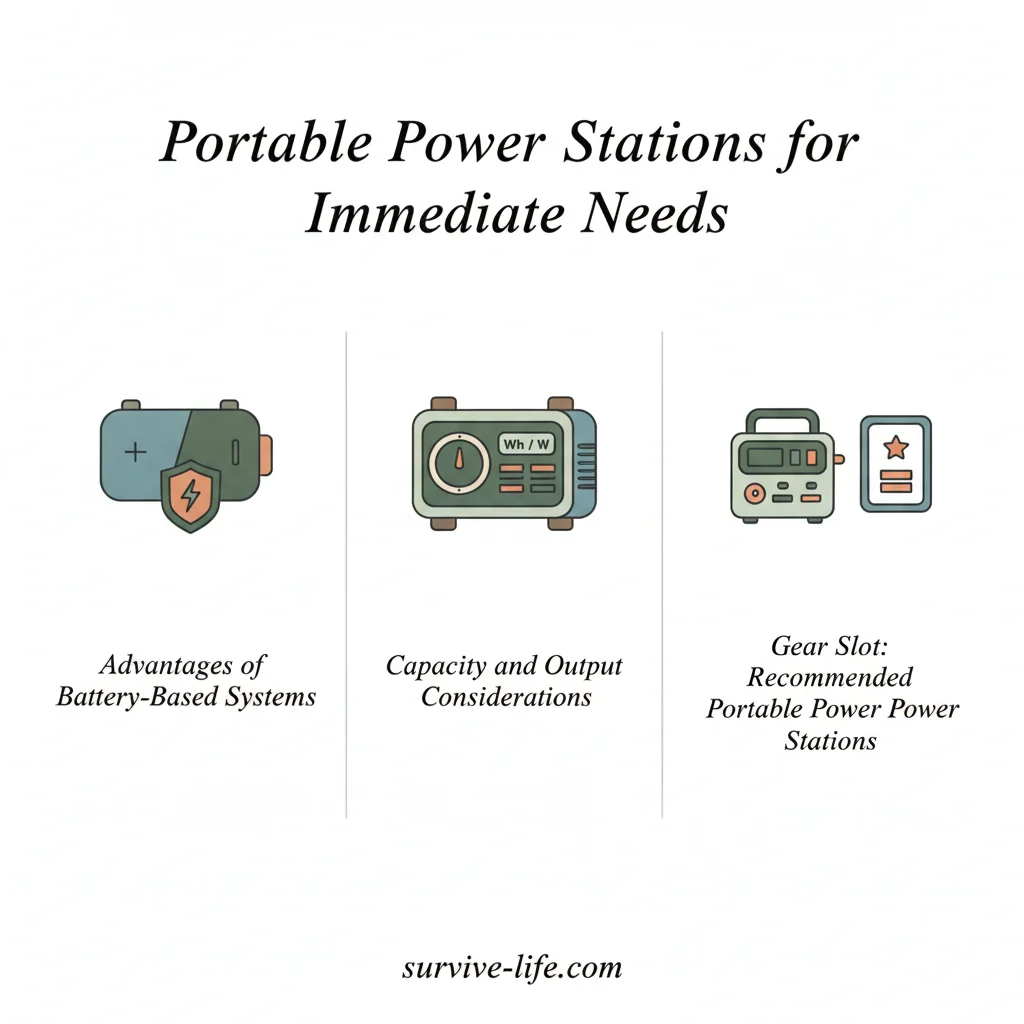
Battery-based systems provide instant power with no noise, no fumes, and minimal maintenance. This makes them perfect for sensitive electronics, medical devices, and indoor lighting. Unlike generators, they do not require ventilation, eliminating carbon monoxide risks. Their plug-and-play operation simplifies emergency setup, reducing stress during a crisis. Furthermore, the absence of moving parts contributes to their high reliability and long lifespan. They are also highly efficient, converting stored energy directly into usable AC or DC power with minimal loss.
Capacity and Output Considerations
Select a unit with sufficient watt-hours (Wh) for run time and continuous wattage output for your devices. A 1000Wh unit can power a 100W device for approximately 10 hours, though actual run times vary based on efficiency and load. Consider models with multiple output types: AC outlets, DC ports, and USB ports. This versatility allows you to power a wide range of devices without needing additional adapters. Ensure the continuous AC output wattage meets the running wattage of your most demanding essential appliance. Also, check the surge wattage capacity to handle initial power spikes from motors. A higher surge capacity prevents the unit from shutting down prematurely. Many units also feature pass-through charging, allowing them to power devices while simultaneously recharging. This capability maximizes uptime during prolonged outages.
Gear Slot: Recommended Portable Power Stations
For reliable performance, consider units like the EcoFlow Delta 2 (1024Wh capacity, 1800W continuous output, 2700W surge). This model offers rapid charging and expandable battery options. Another robust choice is the Jackery Explorer 1000 Pro (1002Wh capacity, 1000W continuous output, 2000W surge). Both units feature robust construction, multiple charging options including solar, and pure sine wave inverters, which are crucial for sensitive electronics. These specifications ensure compatibility and stable power delivery for critical devices. Evaluate your specific wattage and run-time needs before making a final selection.
Inverter Generators: Versatility and Power
When higher wattage or longer run times are necessary, inverter generators offer a robust solution. They are significantly more fuel-efficient and quieter than traditional open-frame generators, making them a preferred choice for residential backup power. Their advanced technology produces clean, stable power, safe for sensitive electronics. This makes them a versatile tool for powering a wider array of household essentials during extended outages.
Fuel Type Selection (Gasoline vs. Propane vs. Dual Fuel)
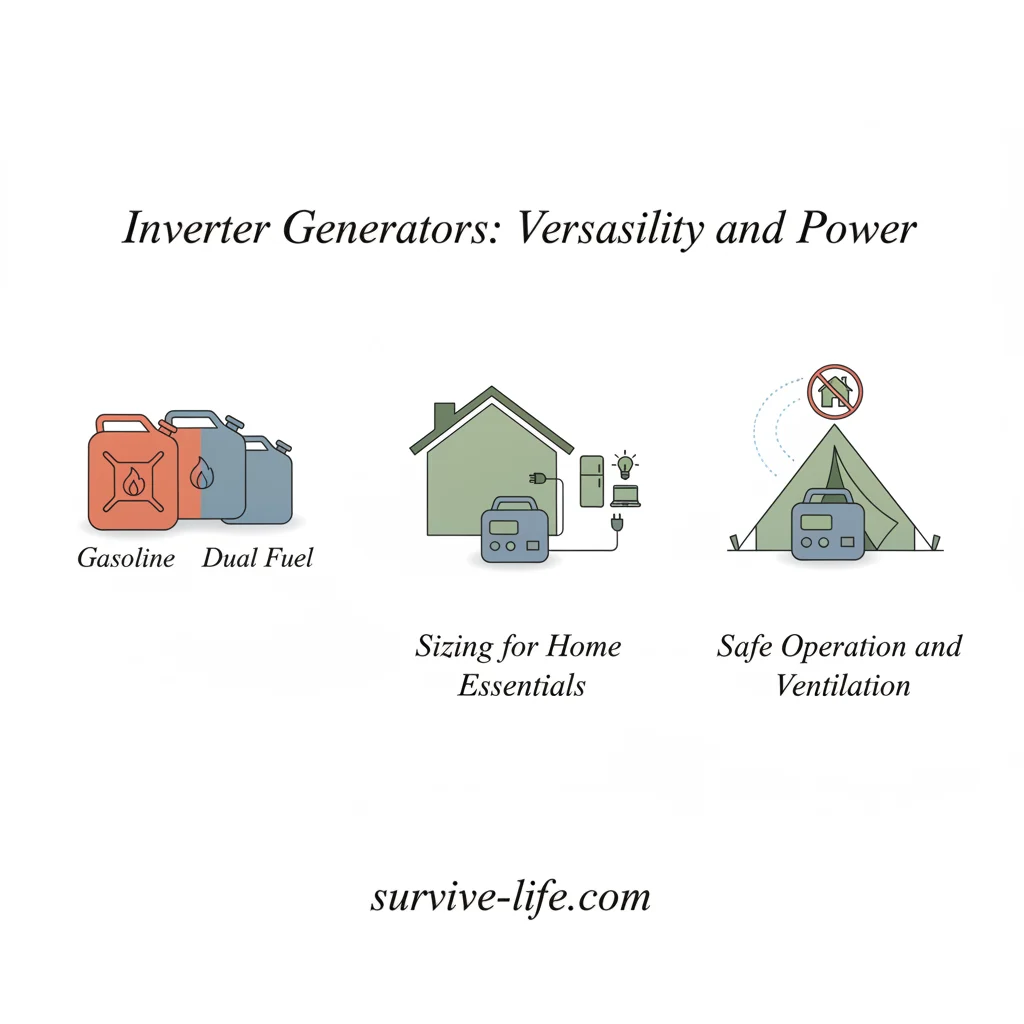
Gasoline is common but has a limited shelf life, typically 3-6 months without stabilizer, or 12-24 months with a quality fuel stabilizer. Propane stores indefinitely and burns cleaner, reducing engine maintenance. Dual-fuel models offer superior flexibility, allowing you to switch between gasoline and propane based on availability or storage convenience. Propane also offers the advantage of being less prone to gumming up carburetors during long storage periods. Consider the availability and storage logistics of each fuel type in your area. Maintaining a diverse fuel supply enhances your preparedness. Furthermore, propane tanks are easier to store safely than large quantities of gasoline.
Sizing for Home Essentials
Match the generator’s continuous running wattage to your calculated critical load. Always factor in a buffer for surge demands, typically 1.5 to 2 times the running wattage for motor-driven appliances. A 3000-5000W inverter generator can typically power a refrigerator, a few lights, a communication device, and perhaps a small window AC unit or a well pump. For larger loads, consider a 7000W or higher unit. Consult the generator’s specifications for both running and surge wattage. Overloading a generator can damage the unit and connected appliances. Therefore, precise sizing is paramount for reliable operation.
Safe Operation and Ventilation
Generators produce carbon monoxide (CO), a deadly, odorless, colorless gas. Always operate generators outdoors, at least 20 feet from any structure, with the exhaust pointed away from windows and doors. The Centers for Disease Control and Prevention (CDC) strongly advises against indoor generator use due to the rapid accumulation of CO. Install battery-operated CO detectors in your home, especially near sleeping areas, and test them regularly. Even brief exposure to high levels of CO can be fatal. Never operate a generator in a garage, even with the door open; CO can still accumulate to dangerous levels. Ensure the generator is placed on a level, dry surface to prevent tipping or electrical hazards. Regularly check fuel lines and connections for leaks. Proper ventilation is not merely a recommendation; it is a life-saving protocol. Maintain a clear area around the generator for adequate airflow and cooling.
Harnessing Solar for Sustainable Power
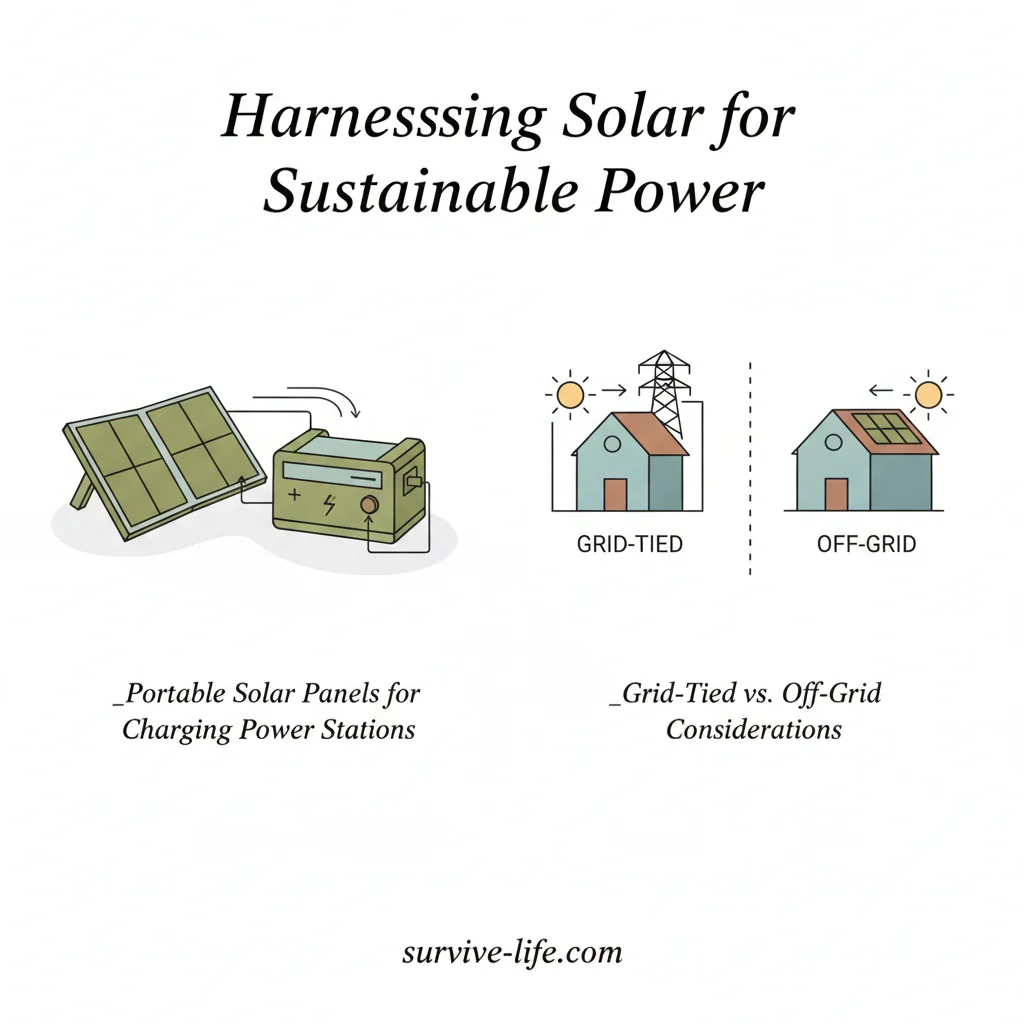
Integrating solar panels provides a renewable charging source for portable power stations, extending their utility indefinitely during prolonged outages. This capability transforms a finite battery supply into a continuous power solution, especially valuable during multi-day or week-long grid failures. Solar power offers independence from fuel supplies and grid infrastructure.
Portable Solar Panels for Charging Power Stations
Foldable, portable solar panels (e.g., 100W-200W) can recharge power stations. Understand that charging times vary significantly based on panel wattage, sunlight intensity, and the power station’s input capacity. A 100W panel in ideal conditions might take 10-15 hours to fully charge a 1000Wh power station. Cloudy conditions or suboptimal panel angles will extend this duration considerably. Position panels directly towards the sun for maximum efficiency. Adjust their angle throughout the day to track the sun’s movement. Most portable panels are designed for easy setup and breakdown, making them practical for emergency deployment. Consider panels with high efficiency ratings, typically 18-22%, for faster charging. Furthermore, ensure compatibility between your solar panels and power station’s input voltage and connector type.
Grid-Tied vs. Off-Grid Considerations
While full off-grid solar systems are complex and require professional installation, even a small, dedicated solar array with battery storage can power critical loads independently of the grid. Grid-tied systems with battery backup (hybrid systems) automatically switch to battery power when the grid fails, then recharge from solar. True off-grid systems are entirely self-sufficient, relying solely on solar generation and battery storage. For most homeowners, a hybrid system offers the best balance of grid convenience and emergency resilience. Research local regulations and permitting requirements for any permanent solar installation. Even a small, dedicated solar setup for a shed or garage can provide auxiliary power for tools or lighting, reducing the load on your primary backup system. This layered approach enhances overall energy security.
Vehicle-Based Power Solutions
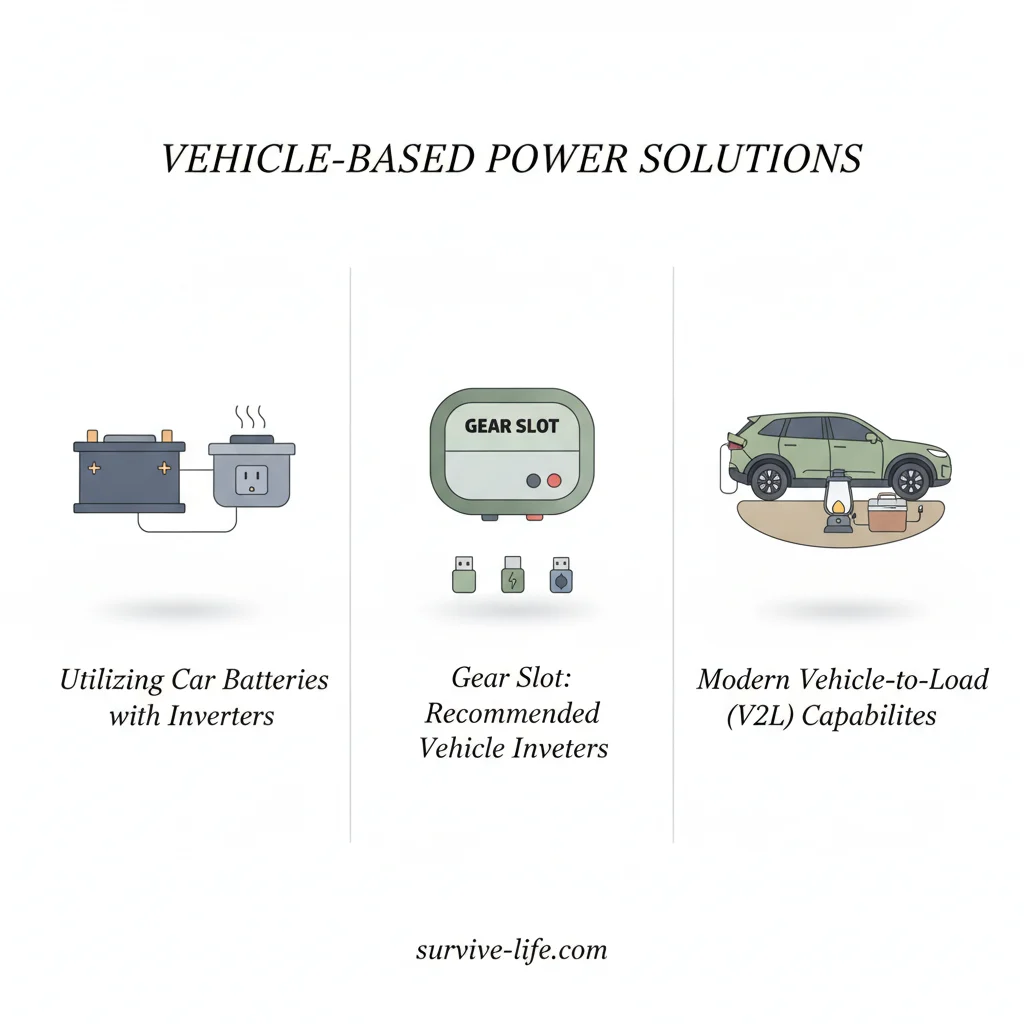
Your vehicle can be a valuable, often overlooked, power resource during an emergency. Modern vehicles possess robust electrical systems capable of providing significant power for critical needs. Understanding how to safely tap into this resource can provide a crucial lifeline when other options are exhausted.
Utilizing Car Batteries with Inverters
A pure sine wave inverter connected directly to your vehicle’s battery terminals (with the engine running to prevent battery drain) can provide AC power for small appliances. Ensure the inverter’s wattage matches your needs and avoid overloading your vehicle’s electrical system. A 1000W inverter is generally the maximum recommended for most standard vehicle alternators without risking damage. Always connect the inverter directly to the battery terminals using heavy-gauge cables. Never use the cigarette lighter port for high-wattage inverters; it cannot handle the current. Run the engine periodically to recharge the battery and prevent it from draining completely. Always ensure proper ventilation when running a vehicle in an enclosed space; carbon monoxide is a silent killer. This method is excellent for charging laptops, phones, and running small medical devices. Monitor your vehicle’s battery voltage to prevent deep discharge, which can damage the battery. A low voltage cutoff feature on the inverter is a valuable safety measure.
Gear Slot: Recommended Vehicle Inverters
For reliable power from your vehicle, a Renogy 1000W Pure Sine Wave Inverter or a Giandel 2000W Pure Sine Wave Inverter are solid choices. Pure sine wave output is crucial for sensitive electronics like laptops, medical devices, and modern appliances, preventing potential damage or malfunction. These inverters typically feature multiple AC outlets and USB ports, offering versatility. Look for models with robust cooling fans and built-in safety features like over-voltage, under-voltage, and short-circuit protection. Ensure the inverter’s continuous wattage rating comfortably exceeds your expected load. Consider the physical size and mounting options for permanent or semi-permanent installation in your vehicle.
Modern Vehicle-to-Load (V2L) Capabilities
Some newer vehicles, particularly electric and hybrid models, offer integrated V2L capabilities. This technology provides significant AC output directly from the vehicle’s charging port or dedicated outlets, effectively turning your car into a large power bank. Vehicles like the Ford F-150 Lightning or Hyundai Ioniq 5 can supply several kilowatts of power, enough to run a substantial portion of a home. Consult your vehicle’s manual for specific V2L output capacities and operational guidelines. This integrated solution eliminates the need for external inverters and complex wiring, offering a seamless and powerful backup option. V2L systems are designed for safety and efficiency, making them a premium choice for vehicle-based emergency power. They represent a significant advancement in personal energy resilience.
Fuel Storage and Management Protocols
For any fossil-fuel-dependent system, proper fuel storage and rotation are paramount for readiness. Neglecting these protocols can render your backup power useless when an emergency strikes. Fuel degradation and unsafe storage practices pose significant risks to both equipment and personal safety. Implement a strict regimen for fuel acquisition, storage, and rotation.
Safe Storage Practices for Gasoline and Propane
Store gasoline in approved, sealed, red plastic or metal containers in a cool, dry, well-ventilated area away from ignition sources. The Environmental Protection Agency (EPA) recommends storing gasoline in quantities appropriate for immediate use, minimizing long-term storage. Never store gasoline inside your home or living spaces due to fire and fume hazards. Propane tanks should be stored outdoors, upright, and away from direct sunlight and heat sources. The National Fire Protection Association (NFPA) advises against storing propane tanks in basements or garages. Ensure tanks are secured to prevent tipping. Regularly inspect containers for leaks or damage. Proper storage mitigates fire risks and maintains fuel integrity. Keep a fire extinguisher rated for Class B fires (flammable liquids) near your fuel storage area. This proactive measure provides immediate response capability in case of an incident.
Fuel Stabilizers and Rotation Schedules
Gasoline degrades over time, forming gums and varnishes that can clog carburetors and fuel injectors. Use a quality fuel stabilizer to extend its shelf life to 12-24 months. Add the stabilizer to fresh gasoline immediately after purchase. Rotate your fuel supply every 6-12 months, using older fuel in vehicles or lawn equipment and replenishing with fresh stock. This ensures your emergency fuel is always viable. Mark containers with the date of purchase and stabilization. Propane does not degrade, but tanks should be inspected periodically for rust or damage. Maintain a sufficient reserve of both fuel types to cover several days of operation for your generator. Never store unstabilized gasoline for more than 3-6 months; it will become unusable and potentially damage your equipment. Implement a clear rotation schedule to avoid fuel-related equipment failures. This disciplined approach guarantees your generator will start and run reliably when needed most.
The Imperative of Preparedness
Relying on the grid without a backup plan is a gamble no prepared individual should take. Implement these solutions, test them regularly, and ensure your household understands their operation. Conduct drills to familiarize everyone with startup procedures, safety protocols, and fuel management. Proactive preparation is the only reliable defense against power outages, transforming potential chaos into manageable inconvenience. Your family’s safety and comfort depend on your foresight and diligence. Do not wait for the lights to go out to realize the value of a robust backup power strategy. Secure your resilience today.