
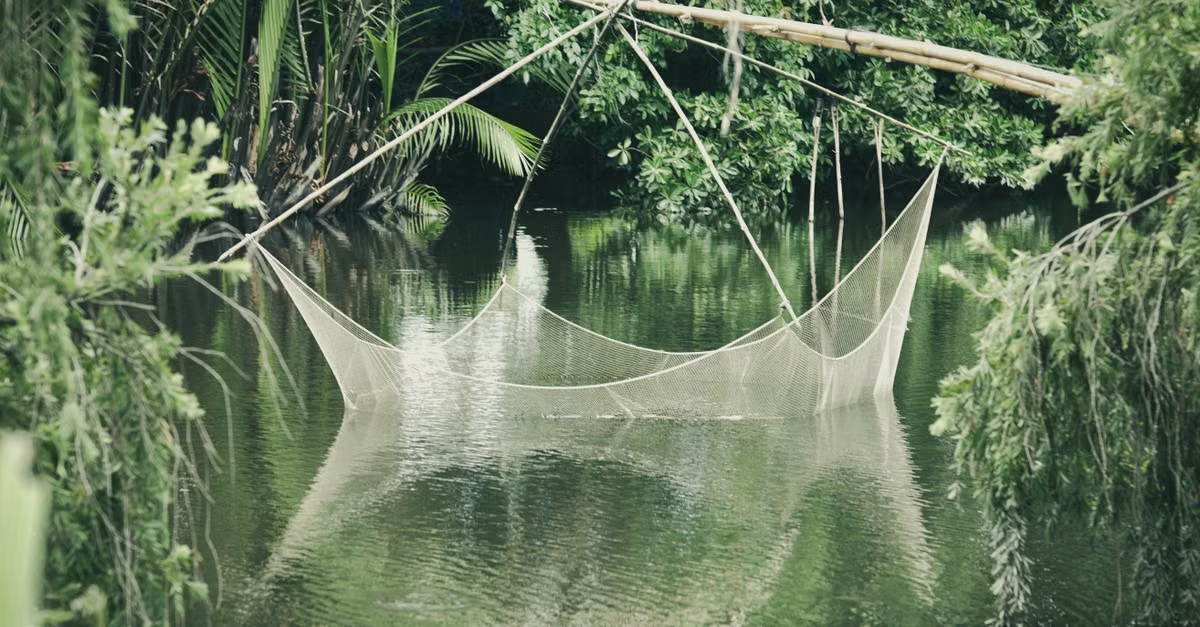
Master essential survival fishing techniques. Learn how to catch fish without a rod using hand-fishing, spears, traps, and improvised hooks. Prepare for any wilderness scenario.
Introduction
Picture yourself in a situation where a traditional fishing rod and reel are simply not an option. Maybe you’re deep in a wilderness survival scenario, honing your bushcraft skills, or just curious about primitive fishing techniques. Whatever the reason, knowing how to catch fish without conventional gear is a valuable skill for any outdoors enthusiast or preparedness-minded individual. This comprehensive guide will equip you with practical, time-tested methods to land a catch using ingenuity, natural resources, and a bit of patience. Get ready to learn the ancient art of fishing, no tackle box required!
The Art of Hand-Fishing (Noodling/Tickling)
What is Hand-Fishing?
Hand-fishing, often called “noodling” or “tickling,” is a primal method where you use your bare hands to catch fish. It’s a direct, tactile approach that connects you intimately with the water and its inhabitants. While it might sound daunting, it’s incredibly effective for certain species, particularly catfish, which often hide in submerged structures.
Finding the Right Spots (Overhangs, Logs, Rocky Crevices)
Success in hand-fishing hinges on finding where fish naturally seek shelter. Look for:
- Undercut banks and overhangs: These provide shade and cover.
- Submerged logs and root systems: Fish hide in the nooks and crannies.
- Rocky crevices and caves: Especially in rivers or lakes with rocky bottoms.
- Brush piles: Any dense underwater vegetation or debris can hold fish.
The Technique: Tickle, Grab, and Hold (Step-by-Step)
- Locate a likely spot: Wade or swim slowly, feeling for submerged structures with your feet or hands.
- “Tickle” for the fish: Once you find a hole or crevice, gently probe it with your fingers. You’re looking for the feel of a fish, often a catfish, which won’t bolt immediately.
- Entice the bite: If you feel a fish, slowly move your fingers around its mouth. Catfish, in particular, are territorial and will often “mouth” your hand, thinking it’s an intruder.
- Make your move: When the fish bites or you feel its head, quickly but firmly grab it by the lower jaw or gills. Be prepared for a strong fight.
- Hold on tight: Pull the fish out of its hiding spot and secure it. A good grip is essential to prevent it from slipping away.
Safety and Legality Considerations
Hand-fishing can be dangerous. Fish have sharp fins, teeth, and spines. Always be aware of your surroundings and potential hazards like snakes or snapping turtles. More importantly, hand-fishing is illegal in many areas due to conservation concerns. Always check local fishing regulations before attempting this method.
Crafting an Improvised Spear
Spearfishing is one of humanity’s oldest hunting methods, requiring stealth and precision. With a bit of ingenuity, you can craft an effective spear from natural materials.
Choosing the Right Shaft (Straight, Sturdy Branch)
Start by finding a straight, sturdy branch, roughly 6-8 feet long and about an inch in diameter. Hardwoods like oak, ash, or hickory are ideal, but any strong, straight sapling will do. Remove all side branches and bark to create a smooth shaft.
Sharpening the Tip (Single Point vs. Multiple Prongs)
- Single Point: For larger fish or deeper water, a single, sharply pointed tip works well. Use a knife or sharp rock to carve a long, tapering point.
- Multiple Prongs (Fishtail/Gig): For smaller fish or shallow water, a multi-pronged spear increases your chances of a hit. Split the end of the shaft into 2-4 prongs, then sharpen each prong. You can insert small, sharpened sticks or bone fragments into the splits and bind them tightly to create barbs.
Hardening the Tip with Fire (Optional, but Effective)
To make your spear tip more durable, slowly pass the sharpened end through a fire. Don’t burn it, but rather char the surface. Scrape off the charred layer, then repeat the process several times. This removes moisture and hardens the wood, making it less prone to breaking or dulling.
Spearfishing Techniques (Stalking, Ambushing, Shallow Water)
- Stalking: Move slowly and quietly along the water’s edge, looking for fish in clear, shallow areas. Approach from downstream if possible, as fish often face upstream.
- Ambushing: Find a spot where fish are likely to pass, such as a narrow channel or a feeding area. Wait patiently, holding your spear ready.
- Shallow Water: This is where spearfishing is most effective. Look for fish hiding in weeds, under rocks, or near submerged logs. Account for water refraction – the fish will appear closer to the surface than it actually is. Aim slightly below where you see the fish.
Setting Up Trotlines and Set Lines
Trotlines and set lines are passive fishing methods that allow you to fish multiple hooks simultaneously, increasing your chances of a catch while you attend to other tasks.
What are Trotlines and Set Lines?
- Set Line: A single fishing line with one or more hooks, anchored at one end and often tied to a tree or stake on the bank.
- Trotline: A longer main line stretched across a body of water or along a bank, with multiple baited hooks attached at intervals using shorter leader lines (snoods).
Gathering Materials (Strong Cordage, Anchors, Floats)
- Cordage: You need strong line. Paracord, braided natural fibers (like twisted inner bark), or even strips of durable fabric can work. The main line should be stronger than the leader lines.
- Hooks: Improvised hooks (discussed later) or salvaged hooks.
- Anchors: Heavy rocks, logs, or stakes driven into the bank to secure the main line.
- Floats (for trotlines): Pieces of buoyant wood, cork, or sealed plastic bottles to keep the main line suspended at the desired depth.
Improvised Baits (Insects, Worms, Small Fish)
Effective bait is crucial. Consider:
- Worms: Dig them up from moist soil.
- Insects: Grasshoppers, crickets, grubs, and beetles are excellent.
- Small fish: If you can catch minnows, cut them into pieces or use them whole for larger predatory fish.
- Frogs/Tadpoles: Good for catfish and bass.
- Berries/Seeds: Some fish, like carp, will take plant-based baits.
Deployment Strategies (Across Rivers, Along Banks, Checking Regularly)
- Across Rivers/Channels: Stretch a trotline from bank to bank in a slow-moving section. Attach anchors to both ends and use floats to keep the hooks suspended.
- Along Banks: Run a set line or trotline parallel to the shore, especially near drop-offs, submerged structures, or weed beds. Anchor one end to a tree or stake and the other to a rock or submerged log.
- Checking Regularly: Check your lines frequently (every few hours) to retrieve catches, re-bait hooks, and prevent fish from rotting or being eaten by scavengers. Don’t leave lines unattended for too long.
Building Simple Fish Traps (Weirs & Basket Traps)
Fish traps are passive, low-effort methods that capitalize on fish behavior. Once built, they can fish for you continuously.
Understanding Fish Behavior (Migration, Feeding Patterns)
Successful trapping relies on knowing where and when fish move.
- Migration: Fish often move upstream or downstream during certain seasons or times of day.
- Feeding Patterns: They congregate in areas with abundant food, like shallow flats or near vegetation.
- Natural Funnels: Look for natural constrictions in waterways that fish must pass through.
Constructing a Weir (Stone or Stick Barrier, Funnel System)
A weir is a barrier that funnels fish into a collection area.
- Choose a location: A shallow stream or river with a moderate current is ideal. Look for a natural choke point.
- Build the barrier: Create a V-shaped or W-shaped barrier across the stream using rocks, logs, or woven sticks. The open end of the “V” should face upstream, directing fish towards the narrow point.
- Create the funnel: At the narrowest point of the “V,” construct a small opening that leads into a collection pen. The opening should be wide enough for fish to enter but difficult for them to exit.
- Build the collection pen: This can be a small enclosure made of rocks or sticks, or you can place a basket trap here. The pen should be large enough to hold several fish.
Making a Basket Trap (Woven Branches, Funnel Entrance)
- Gather materials: Flexible branches (willow, saplings), vines, or strong grasses for weaving.
- Form the body: Weave a cylindrical or conical basket, leaving an opening at one end.
- Create the funnel entrance: Construct a separate, smaller cone that fits inside the main basket. This inner cone should have a wide opening at its base and narrow to a small hole at its tip. Insert this funnel into the main basket, securing it so fish can easily swim in but struggle to find their way out.
- Add weight: Place a few rocks inside the trap to keep it submerged.
Placement and Patience
Place traps in areas where fish are likely to travel or feed:
- Along migration routes: In narrow channels or at the mouth of smaller streams.
- Near cover: Under submerged logs, in weed beds, or near rocky outcrops.
- Baiting: You can add bait (crushed berries, worms, small fish pieces) inside the trap to attract fish.
Traps require patience. Check them regularly, but not so often that you spook the fish. Leave them overnight for best results.
Improvised Netting Techniques
Nets are incredibly efficient for catching multiple fish, especially in shallow water. While making a large net from scratch is time-consuming, smaller, improvised nets are quite feasible.
Using Natural Materials for a Net (Vines, Strong Grasses, Clothing)
- Vines: Flexible vines can be twisted and knotted to create a coarse mesh.
- Strong Grasses/Fibers: If you have access to strong, long grasses or plant fibers (like inner bark from certain trees), you can braid them into cordage and then knot them into a net.
- Clothing: A shirt, blanket, or even a tarp can be repurposed as a net in a pinch.
Creating a Simple Dip Net (Branch Frame, Improvised Mesh)
- Find a sturdy branch: Look for a Y-shaped or U-shaped branch that can serve as the frame.
- Form the hoop: Bend a flexible branch into a hoop and lash it to the Y-shaped branch, or use the U-shape as your frame.
- Attach the mesh: Drape a piece of improvised netting material (a shirt, a piece of woven vine, or even a strong plastic bag with holes poked in it) over the hoop. Secure it tightly with cordage.
- Use: Dip the net into the water, scooping up fish in shallow areas or near vegetation.
Seine Netting with a Partner (If Materials Allow)
If you have a larger piece of fabric (like a blanket, tarp, or large shirt) and a partner, you can create a simple seine net.
- Attach poles: Secure a sturdy stick to each end of the fabric.
- Work together: Each person holds a stick, stretching the fabric between you. Walk slowly through shallow water, dragging the bottom of the net along the streambed.
- Trap the fish: When you feel fish, quickly bring the ends of the net together or lift it out of the water to trap them.
Other Improvised Net Ideas (Shirt, Blanket, Tarp)
- Shirt: Tie off the bottom and sleeves of a shirt, then use the body as a bag net. You can also use two shirts tied together for a small seine.
- Blanket/Tarp: These can be used as a large dip net or a small seine. The key is to move quickly and trap the fish against the bank or another barrier.
Making Your Own Hooks (Gorge Hooks & More)
No hooks? No problem. Humans have been making hooks from natural materials for millennia. These improvised hooks might not look fancy, but they are incredibly effective.
The Classic Gorge Hook (Two-Sided Stick, Line Attachment)
- Find a small, strong stick: Look for a piece of hardwood, bone, or even a thorn, about 1-2 inches long and thin enough to be swallowed by a fish.
- Sharpen both ends: Carve both ends of the stick to a sharp point.
- Attach the line: Tie your fishing line securely around the middle of the stick. The key is that the stick should lie parallel to the line when pulled, but when swallowed and the line is tugged, it rotates and lodges crosswise in the fish’s throat or stomach.
- Baiting: Thread bait (a worm, insect, or small piece of fish) onto the gorge hook, completely concealing the stick.
Carving Bone or Wood Hooks (Sharpening, Barbs)
- Bone: Find a suitable bone (e.g., from a bird or small mammal). Use a sharp rock or knife to carefully carve it into a hook shape. Grind a barb into the inside curve if possible.
- Wood: Hardwoods are best. Carve a small branch or root into a hook. This requires patience and a sharp tool. You can harden the tip with fire as you would a spear.
Using Thorns or Other Natural Points
- Thorns: Large, sturdy thorns from plants like hawthorn or acacia can be used directly as hooks. Simply tie your line to the base of the thorn.
- Claws/Talons: If you find a dried animal claw or talon, these can also be adapted into hooks.
- Shell Fragments: Sharp pieces of shell can be shaped and tied to a line.
Attaching Your Improvised Hook to a Line
Regardless of the material, securely attaching your hook to the line is paramount.
- Notching: For carved hooks, create a small groove or notch near the top of the shank to prevent the line from slipping.
- Lashing: Use a strong knot, like a snell knot or a series of tight wraps, to secure the line. If using a gorge hook, ensure the line is tied precisely in the middle.
- Testing: Always test the strength of your knot and hook before deploying it.
Conclusion
Mastering the ability to catch fish without a rod is more than just a survival skill; it’s a profound connection to ancient human ingenuity and the natural world. From the primal thrill of hand-fishing to the strategic patience of setting traps, the methods outlined here empower you to find food even when modern conveniences are absent. Remember, practice makes perfect, so try these techniques in a safe, legal environment. Always be mindful of local fishing regulations and respect the environment. With these skills in your arsenal, you’ll be better prepared for whatever the wilderness throws your way.